| Doeren Mayhew | |
Change of accounting rules/audit instructions issued on new repair rules
At the end of 2011, the IRS issued comprehensive and far-reaching temporary regulations on the capitalization of costs relating to tangible property. The regulations are generally effective for tax years (or costs incurred in tax years) beginning on or after January 1, 2012. The IRS has now followed up with transitional guidance on how taxpayers can obtain IRS approval to change their method of accounting to comply with the new regulations. In light of the transitional guidance, the IRS's Large Business and International Division (LB&I) followed with a Directive that provides guidance on the handling of audits for various years before and after the regulations take effect. The temporary regulations address two primary areas: (1) whether taxpayers must capitalize or can immediately deduct costs to acquire, produce, or improve tangible property; and (2) whether capitalization of certain expenses requires special adjustments under the depreciation rules. The IRS provided transitional guidance in two revenue procedures to implement the regulations. Because the regulations apply beginning in 2012, the transition guidance applies to accounting method changes for tax years beginning on or after January 1, 2012. Guideline to IRS auditors. The LB&I Directive is addressed to LB&I's examiners and managers, and instructs to cease conducting examinations of repair versus capitalization issues for costs related to tangible property. The Directive applies to both current examinations and new examinations of the repair/capitalization issue for tax years beginning before January 1, 2012, before the regulations apply. Instead, LB&I is reserving its exam activity for issues arising under the temporary capitalization regulations. Guidelines in change-of-accounting approvals. Taxpayers need the IRS's consent to change their method of accounting. The revenue procedures instruct taxpayers how they can obtain automatic IRS consent to change their accounting method(s) to a method permitted under the capitalization-repair temporary regulations. Taxpayers must file Form 3115, Application for Change in Accounting Method, and follow the general procedures for automatic changes described in a 2011 revenue procedure. Ordinarily, a taxpayer cannot request automatic consent to change its accounting method if particular conditions apply, such as the taxpayer being under audit. The IRS waived these "scope limitations" for a taxpayer that changes its accounting method in its first or second taxable year beginning after December 31, 2011. Waiving the scope limitations allows taxpayers to file automatic changes even if they are under examination, without waiting for a window or requesting the IRS's consent. Required adjustments for past years. Taxpayers changing their method of accounting must make a full Code Sec. 481 adjustment, in effect making the regulations retroactive. Taxpayers who undercapitalized their costs under the regulations must go back and figure out the differences in treatment. If the taxpayer has additional income, the taxpayer can recognize the income over four years, beginning in the year of the change. Doeren Mayhew is a Michigan Financial Firm located in Troy, MI.
|
Wednesday, April 11, 2012
Change of accounting rules/audit instructions issued on new repair rules

Wednesday, April 4, 2012
2012 vehicle depreciation dollar limits increase
| Doeren Mayhew | |
2012 vehicle depreciation dollar limits increase
The IRS recently announced revised Code Sec. 280F dollar limitations for vehicles first placed in service during calendar year 2012. Code Sec. 280F(a) imposes dollar limitations on the depreciation deduction for the year the taxpayer places the passenger automobile in service within its business and for each succeeding year. Under Code Sec. 280F(d)(7), the IRS adjusts the amounts allowable as depreciation deductions for inflation.
Code Sec. 280F
Code Sec. 280F(a) imposes dollar limitations on the depreciation deduction for the year the taxpayer places the passenger automobile in service within its business and for each succeeding year. Under Code Sec. 280F(d)(7), the IRS adjusts the amounts allowable as depreciation deductions for inflation.
Bonus depreciation
Another factor to take into account is bonus depreciation. The Tax Relief, Unemployment Insurance Reauthorization and Job Creation Act of 2010 (2010 Tax Relief Act) generally extended the 50-percent additional first-year depreciation deduction under Code Sec. 168(k) to qualified property acquired and placed in service before January 1, 2013 (January 1, 2014 for certain longer-lived and transportation property).
Code Sec. 168(k)(2)(F)(i) increases the first-year depreciation allowed for vehicles subject to the Code Sec. 280F luxury-vehicle limits, unless the taxpayer elects out, by $8,000 to which the additional first-year depreciation deduction applies. The $8,000 amount is not adjusted for inflation. Sport utility vehicles and pickup trucks with a gross vehicle weight rating (GVWR) in excess of 6,000 pounds are exempt from the luxury vehicle depreciation caps.
Rev. Proc. 2012-23
In Rev. Proc. 2012-23, the IRS provides limits for passenger automobiles, light trucks and vans for which the additional first-year depreciation deduction rules under Code Sec. 168(k) apply. Rev. Proc. 2012-23 also provides limits for passenger automobiles, light trucks and vans for which the additional first-year depreciation deduction rules under Code Sec. 168(k) do not apply.
Passenger automobiles. The maximum depreciation limits under Code Sec. 280F for passenger automobiles first placed in service by the taxpayer during the 2012 calendar year are:
Trucks and vans. The maximum depreciation limits under Code Sec. 280F for trucks and vans first placed in service during the 2012 calendar year are:
Leases
Lease payments for vehicles used for business or investment purposes are deductible in proportion to the vehicle's business use. However, lessees must include a certain amount in income during the year the vehicle is leased to partially offset the amounts by which lease payments exceed the luxury auto limits. Rev. Proc. 2012-23 includes tables that identify the income exclusion amounts for passenger automobiles, trucks and vans with lease terms beginning in calendar year 2012.
Call Doeren Mayhew, an accounting firm in Michigan, for more information.
|
Latest IRS Data Book shows jump in higher-income/small business audit rates
| Doeren Mayhew | |
Latest IRS Data Book shows jump in higher-income/small business audit rates
The just-released 2011 IRS Data Book provides statistical information on IRS examinations, collections and other activities for the most recent fiscal year ended in 2011. The 2011 Data Book statistics, when compared to the 2010 version, shows, among other things, a notable increase in the odds of being audited within several high-income categories.
Individual audits
Individual taxpayers collectively were audited at a 1.1% rate over the FY 2011 period, based on 1,564,690 audited returns out of the 140,837,499 returns that were filed. While this rate is about the same as in 2010, variations occurred within the income ranges. An uptick was particularly noticeable in the upper brackets (see statistics, below).
Both correspondence and field audits were counted within the statistics. Correspondence audits accounted for 75% of all audits for FY 2011 (down from 77.1% in FY 2010), while audits conducted face-to-face by revenue agents were only 25% of the total, albeit representing an increase from the 21.7% level in FY 2010. Business returns and higher-income individuals are more likely to experience an audit by a revenue agent; while correspondence audits are generally single-issue audits, a revenue agent is likely to explore other issues "while he or she is there."
Examination coverage: individuals
The following audit statistics taken from the FY 2011 Data Book (and contrasted with FY 2010 Data Book stats) show an increase in the audit rate especially in proportion to adjusted gross income (AGI) level:
Examination coverage: business returns
For individual income tax returns that include business income (other than farm returns), the 2011 audit rate statistics based upon business income (total gross receipts) reveals the IRS's recognition that audits of small business returns yield proportionately higher deficiency amounts:
The difference in audit rates between returns with and without business income, as measured by total positive income of at least $200K and under $1M provide further evidence of the IRS's tendency toward auditing business returns: 3.6% for returns with business income versus 3.2% without in FY 2011 (2.9% versus 2.5% in FY 2010).
Corporate/other returns
The audit rates for corporations are consistent with the deficiency experience that the IRS has had examining corporations of varying sizes. Some selected audit rates include:
|
IRS expands Fresh Start initiative to help economically-distressed taxpayers
| Doeren Mayhew | |
IRS expands Fresh Start initiative to help economically-distressed taxpayers
Building on earlier steps to help taxpayers buffeted by the economic slowdown, the IRS recently enhanced its "Fresh Start" initiative. The IRS has announced penalty relief for unemployed individuals who cannot pay their taxes on time and has increased the threshold amount for streamlined installment agreements.
Fresh Start
Many of the actions that economically-distressed taxpayers would like the IRS to take it cannot by law. The IRS cannot stop interest from accruing on unpaid taxes. The IRS also cannot move the filing deadline.
However, the IRS recognized that it can take some actions to help taxpayers who want to pay their taxes but cannot because of job loss or under-employment. In 2011, the IRS launched its Fresh Start initiative. The IRS made some taxpayer-friendly changes to its lien processes and also enhanced its streamlined installment agreement program for small businesses.
Installment agreements
An installment agreement allows taxpayers to pay taxes in smaller amounts over a period of time. Generally, individuals who owe less than $25,000 may qualify for a streamlined installment agreement. "Streamlined" means that taxpayers do not have to file extra information with the IRS, such as Collection Information Statement (Form 433-A or Form 433-F). The streamlined process is intended to be as simple as possible.
Effective immediately, the IRS has increased the threshold for entering into a streamlined installment agreement to $50,000. The maximum term for streamlined installment agreements has also been raised to 72 months from the current 60 month maximum. Taxpayers generally must pay an installment agreement fee and the IRS charges interest.
Before entering into an installment agreement, taxpayers should explore other options. It may be less expensive to pay your taxes on time with a credit card or a loan. Our office can help you weigh the advantages and disadvantages of an installment agreement.
Unemployed taxpayers
Taxes must be paid when due. This year, the deadline for filing individual returns is April 17, 2012. Taxpayers may request an automatic six-month extension but an extension does not provide additional time to pay.
Individuals who do not file by the deadline may be subject to a failure-to-file penalty. The IRS also may impose a failure-to-pay penalty if a taxpayer does not pay by the due date. The rules for the penalties are inter-related and are also complex.
Both the failure-to-file penalty and the failure-to-pay penalty may apply in any month. In these cases, the five percent failure-to-file penalty is reduced by the failure-to-pay penalty. However, if you file your return more than 60 days after the due date or extended due date, the minimum penalty is the smaller of $135 or 100 percent of the unpaid tax.
Now, the IRS is granting a six-month grace period on failure-to-pay penalties to certain wage earners and self-employed individuals. The IRS explained that the request for an extension of time to pay will result in relief from the failure to pay penalty for tax year 2011 only if the tax, interest and any other penalties are fully paid by October 15, 2012.
Penalty relief is not available to all individuals. The IRS is limiting penalty relief to:
Penalty relief is also subject to income limits. Your income must not exceed $200,000 if your filing status is married filing jointly or not exceed $100,000 if your filing status is single or head of household.
Additionally, the IRS has imposed a cap on the balance due. Penalty relief is restricted to taxpayers whose calendar year 2011 balance due does not exceed $50,000.
If you have any questions about the IRS Fresh Start initiative, please contact Doeren Mayhew, a Michigan CPA firm located in Troy.
|
Contemporaneous tax records: Are you keeping up?
| Doeren Mayhew | |
Contemporaneous tax records: Are you keeping up?
Charitable contributions. For cash contributions (including checks and other monetary gifts), the donor must retain a bank record or a written acknowledgment from the charitable organization. A cash contribution of $250 or more must be substantiated with a contemporaneous written acknowledgment from the donee. "Contemporaneous" for this purpose is defined as obtaining an acknowledgment before you file your return. So save those letters from the charity, especially for your larger donations. Tip records. A taxpayer receiving tips must keep an accurate and contemporaneous record of the tip income. Employees receiving tips must also report the correct amount to their employers. The necessary record can be in the form of a diary, log or worksheet and should be made at or near the time the income is received. Wagering losses. Gamblers need to substantiate their losses. The IRS usually accepts a regularly maintained diary or similar record (such as summary records and loss schedules) as adequate substantiation, provided it is supplemented by verifiable documentation. The diary should identify the gambling establishment and the date and type of wager, as well as amounts won and lost. Verifiable documentation can include wagering tickets, canceled checks, credit card records, and withdrawal slips from banks. Vehicle mileage log. A taxpayer can deduct a standard mileage rate for business, charitable or medical use of a vehicle. If the car is also used for personal purposes, the taxpayer should keep a contemporaneous mileage log, especially for business use. If the taxpayer wants to deduct actual expenses for business use of a car also used for personal purposes, the taxpayer has to allocate costs between the business and personal use, based on miles driven for each. Material participation in business activity. Taxpayers that materially participate in a business generally can deduct business losses against other income. Otherwise, they can only deduct losses against passive income. An individual's participation in an activity may be established by any reasonable means. Contemporaneous time reports, logs, or similar documents are not required but can be particularly helpful to document material participation. To identify services performed and the hours spent on the services, records may be established using appointment books, calendars, or narrative summaries. Hobby loss. Taxpayers who do not engage conduct an activity with a sufficient profit motive may be considered to engage in a hobby and will not be able to deduct losses from the activity against other income. Maintaining accurate books and records can itself be an indication of a profit motive. Moreover, the time and activities devoted to a particular business can be essential to demonstrate that the business has a profit motive. Contemporaneous records can be an important indicator. Travel and entertainment. Expenses for travel and entertainment are subject to strict substantiation requirements. Taxpayers should maintain records of the amount spent, the time and place of the activity, its business purpose, and the business relationship of the person being entertained. Contemporaneous records are particularly helpful. Contact Doeren Mayhew, a Michigan CPA firm located in Troy, for more information.
|
How do I? Amend a return
| Doeren Mayhew | |
How do I? Amend a return
Sometimes in a rush to file your income tax return, you may unintentionally overlook some income that had to be reported, or a deduction that you should or should not have taken. Now what? The solution is usually straightforward: you should file what is called an amended return.
Taxable income is measured on an annual basis so you cannot generally wait on correcting a mistake by "making up the difference" on the return that you file next year. You need to make the correction(s) directly on a revised return for the same tax year. Form 1040X, Amended U.S. Individual Income Tax Return, is used to amend any individual income tax return. Income tax returns other than individual income tax returns or returns filed on Form 1120, U.S. Corporation Income Tax Return, or Form 1120-A, U.S. Corporation Short Form Income Tax Return, are amended by filing the same form originally used to file the return.
Partnerships may use Form 1065X. Amended returns should clearly be marked as such. Some return forms such as Form 1041, U.S. Income Tax Return for Estates and Trusts, contain a box to be checked if it is being filed as an amended return. For returns other than income tax returns, Form 843, Claim for Refund and Request for Abatement, is used to claim a refund.
To amend a non-income tax return other than to claim a refund, the same form originally used to file the return generally should be used. Estate tax returns cannot be amended after they are due. However, supplemental information may be filed that can change the amount of estate tax due from the amount shown on the return.
When to file an amended return. A taxpayer must file an amended return and pay the additional tax due if the taxpayer omitted an item of income or incorrectly claimed a deduction for a tax year for which the limitation period is still open. A tax year ordinarily remains open for three years from the filing of a return. The three-year period starts running the day after the return is filed. A return that is filed early is treated as filed on the due date of the return. The limitations period on assessment for which a return remains open does not start over if an amended return is filed.
If you realize that you made a mistake on your return that is not in IRS's favor, it is best to correct it through filing an amended return as soon as possible. If the IRS starts to audit you and finds the mistake first before you file your amended return, it can assess penalties on the original amount and treat you as if you had not come forward voluntarily on your own.
Special disaster loss option. Not all amended returns are filed to correct a mistake. One in particular -claiming a disaster loss--may be filed to effectively accelerate a casualty-loss deduction. A taxpayer may elect to deduct a disaster loss in the year of occurrence or the immediately preceding year. To qualify for the election, the loss must occur in a federally-declared disaster area. The election is made on a return (if you have not filed your return yet for the preceding tax year), an amended return or a refund claim. The amount of the deduction is determined using the casualty loss limitations.
Contact Doeren Mayhew, a Michigan Accounting Firm located in Troy, for more information.
|
Tuesday, April 3, 2012
FAQ: What is a disregarded entity?
| Doeren Mayhew | |
FAQ: What is a disregarded entity?
A disregarded entity refers to a business entity with one owner that is not recognized for tax purposes as an entity separate from its owner. A single-member LLC ( "SMLLC"), for example, is considered to be a disregarded entity. For federal and state tax purposes, the sole member of a SMLLC disregards the separate legal status of the SMLLC otherwise in force under state law.
As the result of being "disregarded," the SMLLC does not file a separate tax return. Rather, its income and loss is reported on the tax return filed by the single member:
A SMLLC is not the only entity treated as a disregarded entity. Two corporate forms are also disregarded: a qualified subchapter S subsidiary and a qualified REIT subsidiary. However, SMLLCs are by far the most common disregarded entity currently in use.
For federal tax purposes, the SMLLC does not exist. All its assets and liabilities are treated as owned by the acquiring corporation.
Even though a disregarded entity's tax status is transparent for federal tax purposes, it is not transparent for state law purposes. For example, an owner of an SMLLC is not personally liable for the debts and obligations of the entity. However, since the entity is disregarded, the owner is generally treated as the employer of disregarded entity employees for employment tax purposes.
For further details on disregarded entities or how this tax strategy may fit into your business operations, please contact Doeren Mayhew, a Michigan Tax firm located in Troy.
|
April 2012 tax compliance calendar
| Doeren Mayhew | |
April 2012 tax compliance calendar
Employers. Semi-weekly depositors must deposit employment taxes for payroll dates March 28-30.
April 6
April 10
Employees who work for tips. Employees who received $20 or more in tips during March must report them to their employer using Form 4070.
April 11
Employers. Semi-weekly depositors must deposit employment taxes for payroll dates April 4-6.
April 13
Employers. Semi-weekly depositors must deposit employment taxes for payroll dates April 7-10.
April 17
Individuals. Individuals file a 2011 income tax return (Form 1040 or Form 1040EZ) and pay any tax due (an automatic six-month extension to file (but not to pay) is available).
Partnerships. File of 2011 calendar year return (Form 1065). Provide each partner with a Schedule K-1 (Form 1065), Partner's Share of Income, Deductions, Credits, etc., or a substitute Schedule K-1.
April 19
Employers. Semi-weekly depositors must deposit employment taxes for payroll dates April 11-13.
April 20
Employers. Semi-weekly depositors must deposit employment taxes for payroll dates April 14-17.
April 25
Employers. Semi-weekly depositors must deposit employment taxes for payroll dates April 18-20.
April 27
Employers. Semi-weekly depositors must deposit employment taxes for payroll dates April 21-24.
Contact Doeren Mayhew for more information.
|
Wednesday, March 21, 2012
Doeren Mayhew: Top Accounting Firms 2012
Via Accounting Today
Doeren Mayhew was recognized as one of the Accounting Today's 2012 Top 100 Firms
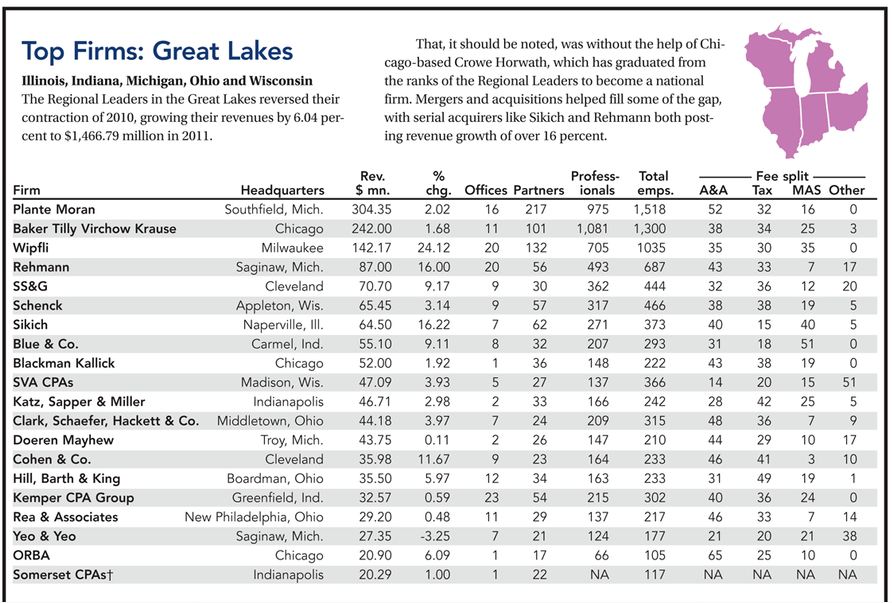

Accounting Today - Top Firms 2012 - Doeren Mayhew
Accounting Today - Top Firms 2012 - Doeren Mayhew - Regional Firms
Wednesday, March 7, 2012
IRS extends deadline for estate tax portability election
| Doeren Mayhew | |
IRS extends deadline for estate tax portability election
The Tax Relief, Unemployment Insurance Reauthorization, and Job Creation Act of 2010 (2010 Tax Relief Act) provided that for decedents dying in 2011, the first $5 million of his or her estate's gross assets would be excluded from the estate tax. If the first spouse of a married couple died in 2011 with a taxable estate worth less than $5 million, the estate would have an unused estate tax exclusion, which it could elect to transfer to the surviving spouse. This "portability election" generally is available if the first spouse dies in 2011 or 2012; the latest extension applies to estates of decedents who died in the first six months of 2011. Following enactment of the 2010 Tax Relief Act, however, the IRS did not come out with guidance (Notice 2011-82) on portability until the end of September, 2011. With estate tax returns due nine months after death, this provided little time for estates to comply with the election requirements. As an answer to this problem, the IRS extended the deadline for certain estates to make a portability election that would allow the surviving spouse to use the remaining amount from the estate and gift tax exclusions of the spouse that was first to die. I am a surviving spouse. How do I make the election? To make the election that would allow the surviving spouse to use the unused exclusion of the deceased spouse, the estate of the deceased spouse must timely file (including extensions) Form 706, the estate tax return. The Form 706 must include a computation of the unused exclusion amount. The portability election can only be made by filing Form 706. How do I obtain an extension of time to file? Estates can obtain a six-month extension of time to file the estate tax return (giving them a total of 15 months), by submitting Form 4768, Application for Extension of Time To File a Return and/or Pay U.S. Estate Tax. Form 4768 must be filed within nine months after death to obtain the additional six-month extension. The extension is available to a qualifying estate, where:
IR-2012-24, Notice 2012-21 Contact Doeren Mayhew for more information.
|
Subscribe to:
Posts (Atom)